
An engine that won’t turn over on a freezing Banff morning doesn’t necessarily mean the car is finished. Cold weather can expose a weak battery, a corroded connection, or a tired starter that coped fine in milder temperatures, and in many cases the fix is far smaller than a new engine. The risk runs both ways: paying for repairs a car can’t justify, or selling a fixable one for far too little.
This guide explains why an engine won’t turn over in cold weather, what to check first, and how to compare repairing the car with selling it as-is, so the decision rests on facts instead of frustration.
Car Won't Start This Winter? Get an Offer As It Is
If the engine won’t turn over and you’d rather not pay for a diagnosis and repair on a car you may not keep, Banff Car Buyers can make you an offer on it as it sits. Call (587) 905-0607 or email hello@banffcarbuyers.ca with the year, make, model, and mileage, and you’ll get a clear answer on what the car is worth to us and how pickup works.
Key Takeaways
The short version, with each point explained in detail below:
- An engine that won’t turn over in winter may have a weak battery, poor electrical connections, a starter problem, or another mechanical or electrical fault.
- Cold weather can make existing starting problems more noticeable, but a no-start condition doesn’t mean the engine is damaged.
- Before replacing parts, get a proper diagnosis so you know what is actually stopping the engine from turning over.
- Repairing the car may make sense when the problem is isolated and the vehicle is otherwise in good condition.
- Selling as-is may be worth considering when repair costs, recurring problems, and upcoming maintenance outweigh the car’s likely remaining value and usefulness.
What Does It Mean When an Engine Won't Turn Over?
When an engine won’t turn over, the starter either isn’t rotating the engine at all (a no-crank condition, with silence or a click) or is turning it too slowly to start it (a slow-crank condition). Both differ from an engine that cranks but won’t start, where the engine turns but never fires up. These problems have different diagnostic paths, which is why telling them apart comes before any repair decision.
The table below lines up common symptoms with what they may point to. These are general clues, not diagnoses, and symptoms alone can’t confirm which part has failed.
| Symptom | Category | What it may point to |
|---|---|---|
| Nothing happens when starting | No-crank | Electrical, starter, or related faults may be involved |
| One clicking sound | No-crank | A possible starter circuit or battery-related problem |
| Rapid clicking | No-crank | Often associated with insufficient electrical power |
| Slow engine cranking | Slow-crank | A weak battery or other starting-system issue may be involved |
| Engine cranks but does not start | Crank-no-start | A different problem involving systems such as fuel, ignition, or engine management |
Slow cranking is technically still turning the engine over, but it often shares causes with a no-crank, such as a weak battery, so both are covered here. If your engine cranks normally but won’t start, the diagnosis points elsewhere, and a technician can narrow it down.
Why Won't Your Engine Turn Over in Cold Weather?
When an engine won’t turn over in cold weather, low temperatures are usually making a weak starting system struggle. Cold reduces what a battery can deliver while the engine needs more effort to turn, so an aging battery, a corroded connection, or a worn starter that coped in mild weather can fail on the first freezing morning. The cause may also be the charging system, thick oil, or another fault.
1. Weak or Dead Car Battery
Batteries become less effective as temperatures drop, which is why a battery that worked fine in October can fail in January. CAA notes that a battery between three and five years old may be near the end of its life, and it recommends checking for corrosion, wetness, or bulges in the casing. Loose or corroded battery connections can also interfere with starting even when the battery itself is healthy. Transport Canada’s winter guidance says to clean the battery posts, check the charging system and belts, and replace weak batteries before they fail.
Quick Tip: Before replacing a battery, have the battery and charging system tested. A failing alternator or poor connection can produce similar starting symptoms.
2. Starter Motor or Starter Solenoid Problems
The starter motor is what rotates the engine during startup, so a failing starter or starter solenoid can leave the engine unable to turn over even when the battery is fine. A single click, intermittent starting, or silence can all be associated with starter problems, though the symptoms vary and can overlap with a weak battery. That overlap is why the starter should be tested before it’s replaced. Replacing a part on a hunch is how owners end up paying for the wrong repair.
3. Alternator or Charging-System Problems
The alternator recharges the battery while the engine runs. If it isn’t doing that properly, the battery can be left undercharged, and the car may turn over fine for a while and then fail on a cold morning. A new battery in that situation may not solve the problem, because a charging fault can leave it undercharged or let it discharge again. This is one reason Transport Canada’s winter checklist includes the charging system and belts alongside the battery itself.
4. Cold Engine Oil and Block Heater Considerations
Cold temperatures can affect how freely engine oil flows, which adds to the effort of a cold start. Use the oil grade your vehicle’s manufacturer recommends, since the right choice depends on the engine and the owner’s manual is the authority on it. A block heater can help prepare the engine for a cold start by warming the engine and oil. CAA suggests considering one when temperatures in your area drop below -15°C, and CAA-Québec’s guidance starts at -5°C, so follow your manufacturer’s recommendations for your vehicle. Owners of pickups and other trucks face the same winter starting issues, and the same repair-or-sell questions apply to them.
5. Other Mechanical or Electrical Faults
Wiring problems, faults in the starter circuit, and other mechanical issues can also stop an engine from turning over, and they’re one reason a proper diagnosis matters more than a guess. This isn’t something to diagnose from the driveway. If the no-start comes alongside collision or other vehicle damage, the repair decision changes, and the options for selling a damaged car in Banff may be part of the comparison.
What Should You Check Before Deciding to Repair or Sell?
Before spending money on parts or deciding the car is beyond repair, identify the actual cause. A few observations cost nothing and help a technician work faster:
- Pay attention to what happens when you try to start the car.
- Note whether the dashboard lights look unusually dim or behave differently than normal.
- Record whether you hear a single click, rapid clicks, or no sound.
- Check the owner’s manual for manufacturer-specific cold-start instructions.
- Have the battery, connections, starter, and charging system professionally tested where appropriate.
- Request a repair estimate before approving expensive work.
Quick Tip: Follow your vehicle manufacturer’s cold-start instructions and avoid repeated, prolonged starting attempts, which can put extra strain on the starting system.
Safety matters here too. Don’t crank the engine repeatedly for long periods, and don’t attempt improvised jump-starts or battery handling you aren’t sure about. Follow the manufacturer’s instructions, and if the car can’t be started safely, call roadside assistance or a qualified technician.
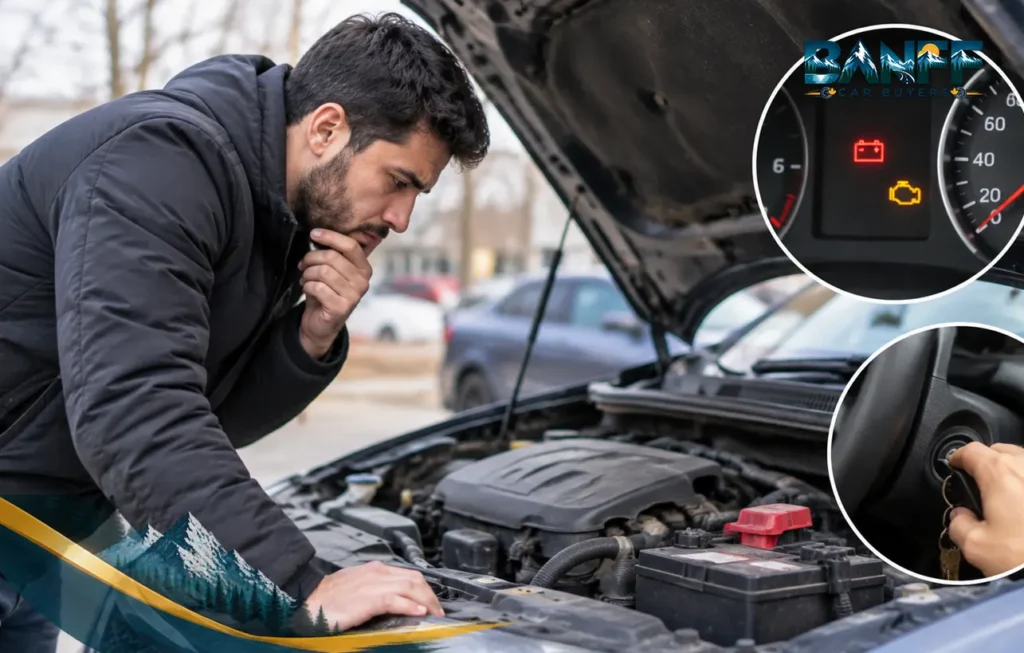
When Is It Worth Repairing a Car That Won't Start?
Repairing the car can make sense when the fault is isolated, the repair is reasonably affordable, and the vehicle is otherwise dependable. Replacing one faulty component on a car that’s in good shape around it is often a sensible decision.
Several factors help you judge that:
- Age and mileage. A newer or lower-mileage car has more years left to benefit from a repair.
- Overall condition. A starting problem on an otherwise sound car is a different decision from one on a car with several issues.
- Scope of the fault. A problem limited to the battery or starter is easier to justify than one tied to deeper problems.
- Maintenance history. A well-maintained car is more likely to stay dependable after a repair.
- Remaining life and upcoming repairs. If other expensive work is approaching, one repair may only delay the next.
For example, if an otherwise well-maintained vehicle only needs a battery replacement, repairing it may make more financial sense than selling it. The calculation changes when the car already has several mechanical problems and the starting issue is only one of many expenses. In Alberta, a licensed repair business must give you a written estimate if you ask for one, so request it before approving a major repair.
Quick Tip: Before approving a major repair, compare the written estimate with the vehicle’s condition, expected remaining life, and realistic value after repair.
When Does Selling Your Car Instead of Repairing It Make More Sense?
Selling as-is may become a practical option when repair expenses are high relative to the vehicle’s condition, expected usefulness, and potential value. It isn’t the only sensible choice, and the right answer depends on your finances and the car’s actual condition.
What If the Repair Estimate Is Higher Than Expected?
A starting-system repair that looked minor can turn into a larger bill once a technician finds the real cause, and an estimate that approaches what the car is valued at changes the economics of keeping an older vehicle. When the number is high, it’s reasonable to get a second written estimate and compare both against the car’s value. If the figures still don’t add up, selling the car as it sits may leave you better off than funding the repair.
What If the Vehicle Already Has Multiple Mechanical Problems?
A starting failure that arrives alongside transmission trouble, electrical faults, heavy wear, or recurring breakdowns tells a different story from a single isolated fault. When one repair is only the first of several, paying for it can mean throwing good money after bad on a car that keeps needing attention. In that situation, selling as-is and putting the money toward a more dependable vehicle may be the more practical path.
What If the Car Has High Mileage and Limited Remaining Use?
Spending more on an older, high-mileage vehicle is harder to justify when other repairs are likely soon. A new battery or starter won’t change the fact that the rest of the car is wearing out. If you drive a truck, the same logic applies, and selling your truck in Banff is one of the options to weigh against a repair that may only buy a little more time.
What If You Don't Want to Keep Investing in the Car?
Some owners simply prefer to move on from an unreliable vehicle rather than keep spending time and money on it, especially in a place where a car that won’t start on a freezing morning is more than an inconvenience. That’s a legitimate reason to sell, as long as it’s based on the car’s actual condition and your own finances. If you’ve already paid for repairs once this winter and the car is failing again, or you no longer trust it to start when you need it, that history belongs in the comparison.
Repair or Sell? How to Compare Your Options
The right choice depends on the specific fault and the car around it. The table below shows how common situations tend to point:
| Situation | Repairing may make sense when | Selling as-is may make sense when |
|---|---|---|
| Weak battery | The rest of the vehicle is dependable | Battery failure is part of recurring electrical problems |
| Starter motor failure | The repair is affordable and the car is in good condition | The vehicle has other expensive mechanical issues |
| Alternator problem | The charging fault is isolated | Several electrical and mechanical components need attention |
| Older high-mileage vehicle | It has a good service history and useful life left | Repairs and upcoming maintenance are becoming excessive |
| Major engine problem | The vehicle's value and condition justify the repair | The repair cost is disproportionate to its likely value and usefulness |
| Multiple recurring problems | The owner has a clear and affordable repair plan | Continuing ownership is becoming financially impractical |
The same comparison works across the whole car:
| Factor | Repair the vehicle | Sell as-is |
|---|---|---|
| Vehicle condition | Otherwise dependable | Multiple existing problems |
| Starting problem | Isolated, repairable fault | Expensive or recurring fault |
| Repair estimate | Reasonable relative to vehicle value | Disproportionate to vehicle value |
| Mileage | Lower or moderate, with good maintenance | High, with considerable wear |
| Future expenses | Few major repairs expected | Several upcoming maintenance expenses |
| Owner's priority | Wants to keep using the vehicle | Wants to move on from the vehicle |
Neither column is always the better one. What the tables can do is stop you from judging the decision by the price of a single part. A useful comparison adds up the total diagnosis and repair expense, any towing or additional repairs, the car’s realistic value after repair, what you could get selling it as-is, and the likely cost of future maintenance.
Quick Tip: Compare the cost of repairing the vehicle with an as-is offer and the expenses you may face from future maintenance. Consider the total financial picture instead of a single repair.
Which Questions Should You Ask Before Deciding?
Work through these questions in order, since the answers to the first few decide how much the later ones matter:
- Does the engine fail to crank, or does it crank without starting?
- Has the actual problem been diagnosed?
- Is the battery in good condition?
- Could the starter or charging system be faulty?
- What is the total estimated repair cost?
- Is the vehicle otherwise mechanically dependable?
- How many kilometres has it travelled?
- Are other major repairs approaching?
- What is its realistic value after repair?
- What could it be worth in its current condition?
- Do I still want to invest in and maintain this vehicle?
How Do Banff's Winter Conditions Affect Cold-Weather Starting Problems?
Banff’s winters are cold enough to expose a starting system that’s already weak, which is often why an engine won’t turn over in winter here. January is the coldest month, with average lows around -15°C, and temperatures can drop into the minus thirties. Mountain weather also varies a lot from one week to the next, so a car that starts fine one morning can fail the next. CAA-Québec notes that at -30°C a battery holds only about 25 percent of its capacity.
That context makes a few habits more important for anyone parking outside overnight in Banff:
- Check the battery before winter. An older battery is the most likely casualty of a cold snap.
- Keep up with winter maintenance. Transport Canada recommends a pre-winter check of the battery, charging system, and belts.
- Use the manufacturer’s recommended oil. The owner’s manual sets the grade for your engine.
- Consider a block heater. CAA suggests one when temperatures drop below -15°C, which Banff’s January lows approach.
- Don’t ignore repeated starting trouble. Slow cranking or occasional failures are early warnings, and they tend to show up first in the coldest weather.
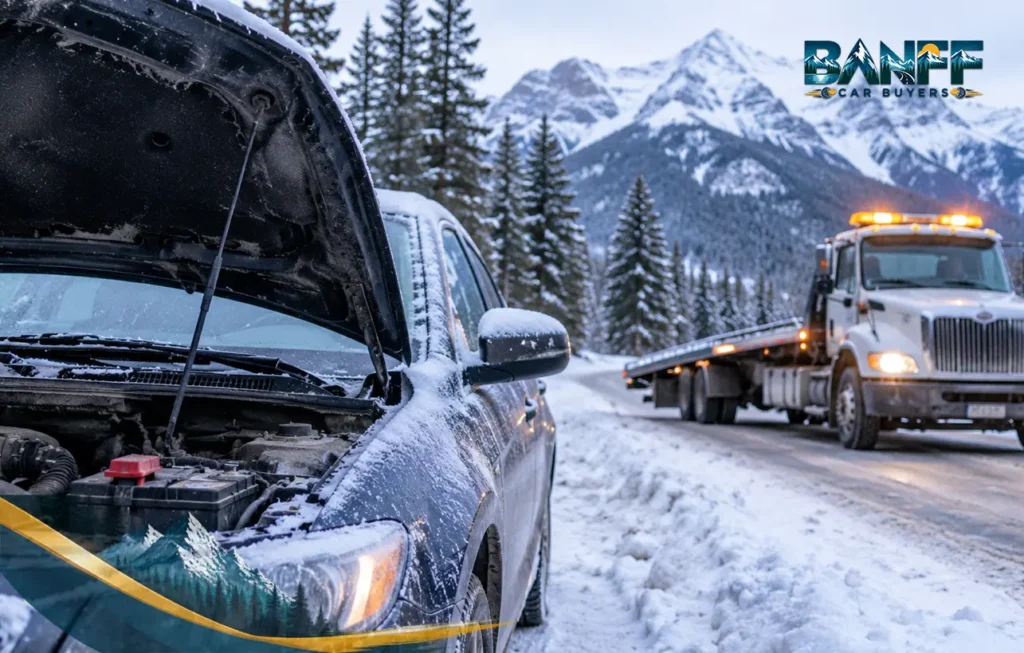
A car that can’t move also creates its own logistics. It can’t be driven to a shop or a buyer, and it may need a tow before anyone can assess it, which belongs in the decision.
What If You Decide Not to Repair Your Non-Running Car?
You don’t need to restore a car to running condition before considering a sale. If repairing it no longer makes financial sense, another option is to explore selling it in its current condition. Owners looking into how to sell a non-running car in Banff can review the available options without first assuming the vehicle needs to be repaired.
At a high level, the options are selling privately as-is, contacting a buyer that accepts non-running cars, or getting an as-is offer before approving expensive repairs. Whichever you choose, compare the offer with the repair estimate and what the car would be valued at once running.
Get an Offer on a Car That Won't Start
If a diagnosis and estimate have you leaning toward selling, Banff Car Buyers can give you an offer on the car as it sits, without a repair first. Call (587) 905-0607 or email hello@banffcarbuyers.ca with the year, make, model, mileage, and a short description of what the car is doing, and you’ll get a straightforward answer on what the offer would be.
Common Questions About Cars That Won't Start in Winter
Why won't my engine turn over in cold weather?
Cold reduces battery output and makes the engine harder to turn, so a weak battery, corroded connections, a worn starter, or a charging-system fault can show up on the first freezing morning. Thick oil adds strain. A proper test, not guesswork, shows which part is actually responsible.
Can cold weather prevent a car engine from turning over?
Yes, it can. Cold temperatures reduce what a battery can deliver, and a weakened battery may not supply enough power to turn the engine. That doesn't mean the engine is damaged, though. Often the battery or connections are the weak point, and the car starts normally once that's addressed.
Is it my battery or starter if my car won't turn over?
It can be either, and symptoms alone can't confirm which. Dim lights and rapid clicking are often associated with a weak battery, while a single click with bright lights may suggest a starter-circuit problem. Testing the battery, starter, and charging system shows the real cause before you buy parts.
Why does my car make a clicking noise when I try to start it?
Clicking usually means something is trying to engage but isn't getting enough power or isn't turning the engine. Rapid clicking is often associated with a weak battery or poor connections, while one click can involve the starter or its circuit. Treat it as a clue and get the system tested.
Does an engine block heater help a car start in winter?
It can. A block heater warms the engine and oil so the battery has less work to do on a cold start. CAA suggests considering one when temperatures drop below -15°C, and CAA-Québec's guidance starts at -5°C. Follow your manufacturer's recommendations and check that the cord and plug are intact.
Should I repair an old car that won't start?
It depends on the confirmed cause and the car's overall condition. A battery or connection problem on an otherwise dependable car is often reasonable to fix, while an expensive repair on a high-mileage car with other issues coming may not be. Get a written diagnosis and estimate before deciding.
Is it worth replacing a starter motor on an older vehicle?
It can be, if the rest of the car is dependable and the starter was properly diagnosed as the cause. Compare the written estimate with the car's value and expected remaining life. If other major repairs are approaching, the same money may be better directed elsewhere.
Can I sell a car that won't turn over in Banff?
Yes. A car that won't turn over can be sold as-is, either privately or to a buyer that accepts non-running vehicles, and you don't have to repair it first. Describe the problem accurately, complete a bill of sale, and compare any offer with the repair cost. Here are the options for a car that won't start.
Is a non-running car worth anything?
Often yes, though the amount varies. Value depends on the vehicle's age, condition, and what's wrong with it, and a non-running car isn't necessarily worthless. Because no single price applies to every car, compare an as-is offer with the repair estimate instead of assuming it has no value.
When should I stop repairing my old car?
Consider stopping when repair estimates approach the car's value, the same problems keep coming back, or several major repairs are due at once. It also makes sense when you no longer trust the car for winter driving. Compare total repair costs with what you could get selling as-is.
Final Thoughts
Cold weather can expose starting-system problems that were already developing, and when an engine won’t turn over in winter, that doesn’t mean the engine itself has failed. A proper diagnosis should come before replacing expensive components, since a weak battery, a starter fault, and a charging problem can look alike. Repairing the car may be sensible when the issue is isolated and the vehicle is otherwise dependable. Selling as-is may be more practical when repairs and future maintenance become disproportionate to the car’s value and usefulness. The final decision should rest on the vehicle’s actual condition and your own priorities.
A car that won’t turn over in winter isn’t necessarily a vehicle that needs to be scrapped. Once you understand the cause and compare the potential repair expenses with the vehicle’s current condition, you can make a more informed decision. If repairing it no longer makes sense, Banff vehicle owners can also explore the option of selling a non-running car in its current condition.
References
Transport Canada. Preparing your vehicle for winter. https://tc.canada.ca/en/road-transportation/stay-safe-when-driving/winter-driving/preparing-your-vehicle-winter
CAA National. Winter Car Care. https://www.caa.ca/driving-safely/winter-driving/winter-car-care/
CAA-Québec. Preparing your car for winter. https://www.caaquebec.com/en/advices/maintaining-a-vehicle/preparing-your-car-for-winter
Parks Canada. Weather conditions, Banff National Park. https://parks.canada.ca/pn-np/ab/banff/securite-safety/meteo-weather
Alberta Motor Vehicle Industry Council. Repairing a vehicle. https://www.amvic.org/consumer/repairing-a-vehicle/