A vehicle that stops running for good doesn’t just leave its owner stranded. Inside a national park, it raises a second question most people never think about until it happens: what’s dripping out of it, and where does that go. Banff sits directly on the Bow River, and a vehicle that’s been leaking oil, coolant, or brake fluid for even a short time isn’t just a cosmetic problem here, since the water this landscape depends on is never far from wherever the vehicle happens to be parked. Federal law actually places responsibility on whoever’s in charge of that vehicle to prevent exactly this kind of harm, and how a vehicle gets picked up matters as much as anything that happens to it afterward. This piece covers what actually creates risk, how a dead vehicle should be handled responsibly here, and honestly, what happens to it once it’s sold.
Sell Your Vehicle Before a Small Leak Becomes a Bigger Problem
If you have a vehicle that’s stopped running and it’s sitting somewhere near the water or on unpaved ground, waiting doesn’t make the situation any simpler. Banff Car Buyers can arrange pickup and get it off your property before a slow leak turns into a cleanup job, handling the vehicle carefully on the way out rather than treating it as just another tow. Call (587) 905-0607 or email hello@banffcarbuyers.ca with the year, make, model, and whether you’ve noticed any leaking, and you’ll get a straightforward answer on getting it moved.
Is There One Eco-Friendly Disposal Process in Banff?
No. A vehicle that dies here passes through several different hands before it’s actually recycled, and each stage has its own business, its own rules, and its own environmental stakes attached to it. Understanding that sequence shows where the real risk sits and who’s actually responsible for managing it at each point.
Pickup, Sale, and Recycling Happen With Three Different Businesses
Practically speaking, three things happen. Someone has to remove the vehicle, ideally before it sits long enough to leak onto the ground or into a storm drain. It gets sold, whether to a buyer, a dismantler, or a private party. And it eventually gets dismantled or recycled by whoever ends up with it, which is rarely the same business that first picked it up. Car disposal in Banff isn’t a single company running a single process from pickup to recycling. It’s a chain, and the first link, how the vehicle is handled at pickup, is the part that actually matters most for the park itself.
Why the First Step Gets Overlooked
That first link gets overlooked because it doesn’t look like the interesting part of the story. Nobody markets “we drove carefully to the impound lot” the way they might market “eco-friendly recycling,” but in a place where the Bow River is never far from wherever a vehicle happens to be sitting, careful handling at pickup is worth more than a recycling process that happens somewhere else entirely, weeks later, at a facility the original buyer may never even see the vehicle reach.
A vehicle that stops running for good doesn’t just leave its owner stranded. Inside a national park, it raises a second question most people never think about until it happens: what’s dripping out of it, and where does that go. Banff sits directly on the Bow River, and a vehicle that’s been leaking oil, coolant, or brake fluid for even a short time isn’t just a cosmetic problem here, since the water this landscape depends on is never far from wherever the vehicle happens to be parked. Federal law actually places responsibility on whoever’s in charge of that vehicle to prevent exactly this kind of harm, and how a vehicle gets picked up matters as much as anything that happens to it afterward. This piece covers what actually creates risk, how a dead vehicle should be handled responsibly here, and honestly, what happens to it once it’s sold.
Sell Your Vehicle Before a Small Leak Becomes a Bigger Problem
If you have a vehicle that’s stopped running and it’s sitting somewhere near the water or on unpaved ground, waiting doesn’t make the situation any simpler. Banff Car Buyers can arrange pickup and get it off your property before a slow leak turns into a cleanup job, handling the vehicle carefully on the way out rather than treating it as just another tow. Call (587) 905-0607 or email hello@banffcarbuyers.ca with the year, make, model, and whether you’ve noticed any leaking, and you’ll get a straightforward answer on getting it moved.
Why Fluid Containment Matters Near the Bow River
Two things make it a real issue here rather than a general reminder to check for leaks: a specific obligation written into federal law, and Banff’s own location, which puts most of the townsite within reach of the same river.
The Legal Obligation Under Section 32
Section 32 of the Canada National Parks Act puts a real, specific obligation on the table: when a substance capable of degrading the natural environment is discharged or deposited in a park, whoever has charge, management, or control of that substance has to take reasonable measures to prevent the harm. A leaking vehicle can create exactly that situation, since motor oil, coolant, brake fluid, and gasoline are all substances the law has in mind, and a park superintendent who decides those measures aren’t being taken can direct someone to fix it, with real consequences for ignoring that direction.
Why Banff's Geography Raises the Stakes
Banff’s setting makes this more than an abstract legal point. The Town of Banff itself says almost everything that enters a storm drain flows directly into the Bow River untreated, and it names automotive fluids, things like antifreeze and brake fluid, as one of the five most common hazardous materials found in that runoff. A vehicle parked for weeks with a slow leak isn’t just an eyesore in a place like this. It’s the exact scenario the law is written to prevent, and it’s a distinctly different risk profile than the same leaking vehicle would present sitting in a driveway in a landlocked Alberta town where the nearest waterway is kilometres away.
How Should a Dying Vehicle Be Handled Before Pickup?
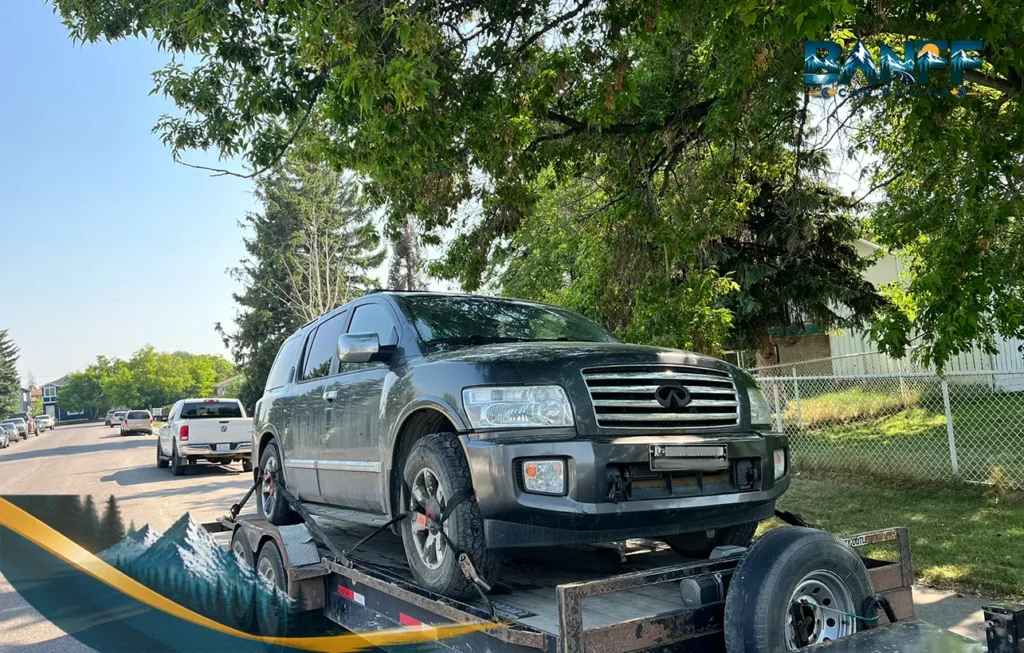
Most of what matters here happens before anyone shows up with a tow truck, and none of it requires special equipment or expertise, just a bit of attention while the vehicle is still sitting on the property. A few practical habits make a real difference while a vehicle is waiting to be picked up:
- Don’t let it sit on gravel, grass, or bare ground if it’s leaking. A driveway or a paved surface is easier to clean up if something does drip.
- Tell whoever’s arranging pickup about any known leak before they arrive, rather than letting them find out on-site.
- Ask how the vehicle will actually be moved. A vehicle loaded onto a flatbed, rather than dragged or driven short distances, is a reasonable way to reduce the chance of spreading whatever it’s leaking along the way.
- Avoid moving a leaking vehicle any closer to a ditch, storm drain, or the riverbank than it already is, even temporarily.
- If the vehicle has been sitting long enough to stain the ground underneath it, mention that too, since a stained patch of gravel or soil is worth flagging even after the vehicle itself has been removed from the property.
None of this requires special training or equipment. It just means treating a leak as something to manage rather than something to ignore until the vehicle is gone.
What Happens to a Vehicle After It's Sold?
Once a vehicle is sold, it typically moves on to another business, a dismantler, a recycler, or another buyer, rather than being processed on the spot by whoever bought it first. It’s simply not accurate to describe that process as any single company’s in-house operation when the vehicle changes hands more than once along the way.
What Actually Counts as Eco-Friendly Recycling
“Eco-friendly” isn’t just a phrase a business can claim without something to back it up. One established industry standard is the Canadian Auto Recyclers’ Environmental Code (CAREC), developed by the Automotive Recyclers of Canada, originally in cooperation with Environment Canada, to promote environmentally responsible end-of-life vehicle recycling. Direct members of the Automotive Recyclers of Canada must undergo independent third-party auditing and certification to CAREC, and the code sets out specific requirements covering the whole process, not just the headline result:
- Draining and properly handling fluids such as oil, coolant, and fuel before dismantling begins
- Managing hazardous components, including mercury switches, airbags, and batteries, separately from general scrap
- Removing reusable parts for resale before the remaining metal is recycled
- Keeping the whole operation aligned with federal, provincial, and municipal environmental rules
That distinction is useful for a seller to know, since it gives you something concrete to ask about instead of taking an “eco-friendly” claim at face value.
- Read Also:
Why the Recycling Step Has Real Environmental Value
The upside isn’t abstract, either. Steel is one of the most recyclable materials that exists, and recycling it takes substantially less energy than mining and refining new steel from ore, since the metal doesn’t have to be extracted and smelted from scratch. The same logic applies to the aluminum, copper, and other metals in a typical vehicle. Reusing salvaged parts, rather than manufacturing new ones, cuts even further into the raw materials and energy a replacement part would otherwise require.
None of that happens on its own, though. It depends on the vehicle actually reaching a recycler that follows a standard like CAREC, rather than sitting somewhere it shouldn’t, or ending up with an operation that skips the fluid handling and hazardous material steps altogether. That’s the real difference between a vehicle that’s disposed of responsibly and one that just disappears.
For Banff specifically, the step before all of that is what a seller here actually controls: getting a leaking or non-running vehicle off the property and away from the watershed without making a bigger mess on the way out. That’s the part of the chain that happens in the park itself.
Sell Your Vehicle Before a Small Leak Becomes a Bigger Problem
If you have a vehicle that’s stopped running and it’s sitting somewhere near the water or on unpaved ground, waiting doesn’t make the situation any simpler. Banff Car Buyers can arrange pickup and get it off your property before a slow leak turns into a cleanup job, handling the vehicle carefully on the way out rather than treating it as just another tow. Call (587) 905-0607 or email hello@banffcarbuyers.ca with the year, make, model, and whether you’ve noticed any leaking, and you’ll get a straightforward answer on getting it moved.
Conclusion
Car disposal in Banff isn’t really about one eco-friendly process, since no single business handles a vehicle from pickup to final recycling. It’s about getting the first step right: removing a dead vehicle carefully, especially one that’s leaking, given how directly the Town’s own stormwater system connects to the Bow River. Section 32 of the Canada National Parks Act backs that up with a real legal obligation, not just good manners, and Parks Canada takes reports of pollution seriously enough to list it alongside poaching and littering as an offence it wants to hear about. What happens to the vehicle after it’s sold is a separate question, governed by its own industry standard in the Canadian Auto Recyclers’ Environmental Code, and keeping those two questions apart is what actually helps a seller, since it shows exactly where their own responsibility ends and someone else’s begins.
Key Questions Answered
Is it illegal to let a vehicle leak fluids in Banff?
There's no rule naming vehicle leaks specifically, but section 32 of the Canada National Parks Act requires anyone in charge of a substance capable of harming the environment to take reasonable steps to prevent that harm. A leaking vehicle can create exactly that situation.
Does a car buying service recycle the vehicles it buys?
Usually not. A car buying service typically buys the vehicle and resells it to another business, often a dismantler or recycler, who handles the actual recycling. The buyer's role is picking up and purchasing the vehicle, not processing it afterward.
What makes a vehicle recycler eco-friendly?
One recognized industry standard in Canada is the Canadian Auto Recyclers' Environmental Code. Members certified to it pass an independent audit covering proper fluid drainage, safe handling of hazardous parts like batteries and airbags, and salvaging reusable parts before the remaining metal is recycled.
What should I do if my dead vehicle is leaking fluid?
Move it onto pavement if you can, away from grass, gravel, ditches, or the riverbank, and tell whoever's arranging pickup about the leak beforehand. That gives them a chance to handle the vehicle appropriately rather than finding out on arrival.
Why does the Bow River matter for car disposal in Banff?
The Town of Banff says almost everything that enters a storm drain flows directly into the Bow River untreated, and automotive fluids are among the most common pollutants found in that runoff, so a leaking vehicle here has a far more direct path to the water than in most Alberta towns.